What asks to be seen
Painting, drawing, sculpture, photography, film, illustration, design, and visual forms still becoming.
The Lux Story Book · Chapter III
Art is one of the ways the divine remembers how to speak through human hands.
Enter the storyPreserve the gift. Sustain the giver.
The ancient threshold
Before the gallery, the stage, the bookshop, the screen, or the sale—there was the human need to meet what could not be fully explained.
Across centuries and cultures, artists have given form to prayer, grief, ancestry, wonder, resistance, remembrance, and the sacred. Through image, rhythm, movement, language, material, and story, they have helped humanity approach what one person may call God, another spirit, nature, imagination, collective consciousness, truth, or the unnamed source of creation.
The artist stands at the threshold between what can be seen and what can only be felt.
“The precise role of the artist, then, is to illuminate that darkness, blaze roads through that vast forest, so that we will not, in all our doing, lose sight of its purpose, which is, after all, to make the world a more human dwelling place.”
The act of translation
An artist does not merely manufacture an object. The artist listens, receives, interprets, practices, revises, and translates. They enter the unknown and return carrying color, movement, image, rhythm, form, and story.
The finished work may appear sudden. Behind it are years of attention, repeated gestures, abandoned attempts, learned techniques, inherited knowledge, and the courage to remain with something before anyone else can see what it might become.
Inspiration may arrive as a gift. Giving it a form is labor.
The many vessels
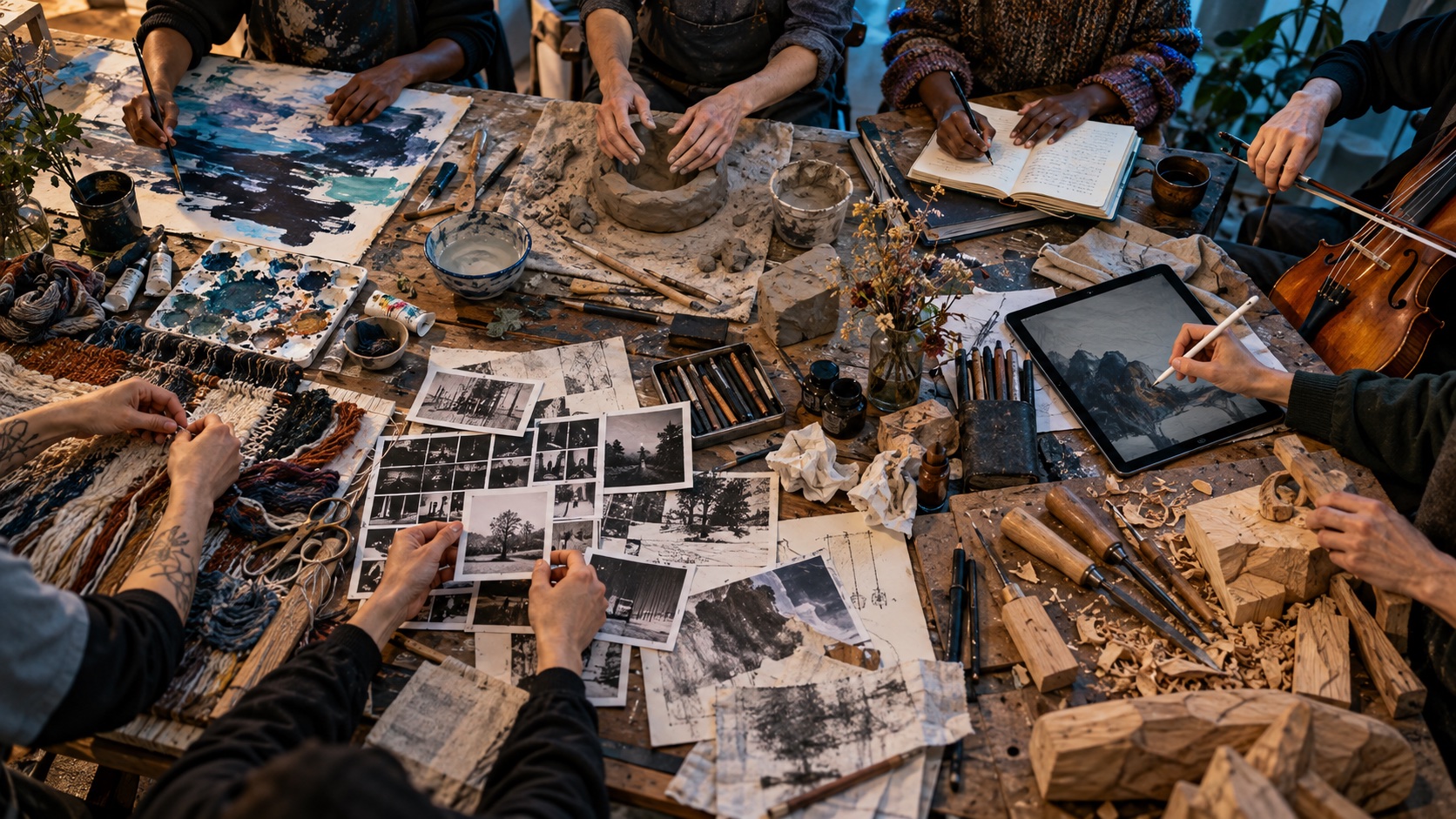
The channel may open through a mural, a melody, a poem, a vessel, a garment, a dance, a meal, a photograph, a performance, a garden, a film, a carved object, a digital world, or a form no institution has named yet.
Painting, drawing, sculpture, photography, film, illustration, design, and visual forms still becoming.
Music, song, composition, spoken word, sound art, production, and the audible architectures of belonging.
Dance, theatre, performance, ritual, movement, and every work that exists fully only through presence.
Poetry, fiction, essays, scripts, oral histories, translation, and the stories communities keep alive.
Clay, fiber, wood, metal, food, books, garments, tools, and knowledge carried from hand to hand.
Participatory, digital, ecological, social, ceremonial, and hybrid practices widening what art may become.
The circle of remembering
When inherited systems can no longer carry life forward, creation becomes a way of recovering relationship—with one another, with the unseen, and with the living Earth. The artist can become a keeper of memory and a maker of passage: not claiming another people's sacred identity, but accepting the responsibility to listen, protect, plant, and reveal.
Carry ancient questions and hard-won truths across generations, so a people do not have to begin without memory.
Sow images, words, practices, and gathering places whose full meaning may flower beyond their own lifetime.
Creation becomes
a path of return.
Keep what is sacred from being flattened into a product: land, lineage, consent, community, and living difference.
Walk toward realities that do not yet have proof, then leave enough light for others to find their own way.
Rebirth is not an escape from the Earth. It is a return to relationship with her.
These roles are not ranks or titles. They are movements within a living circle—distinct, connected, and capable of passing from one person to another whenever the work requires them.
Movement one
What happens when a culture depends upon creative sensitivity while refusing to sustain the people who carry it?
“Artists are here to disturb the peace.”
The central contradiction
We preserve the work while forgetting the worker.
We praise the masterpiece while overlooking the life required to create it.
We fill our homes, ceremonies, screens, cities, and memories with art—then treat the artist's need to live as an inconvenience.
The world we ask artists to survive
The sensitivity that helps a person perceive what others miss can become painful inside systems organized around conformity, constant productivity, sensory overload, financial insecurity, and emotional suppression.
Artists are not inherently ill. Neurodivergence is not a defect, and suffering is not proof of creative legitimacy. Yet some artists live with depression, trauma, anxiety, addiction, burnout, or nervous systems continually asked to function in surroundings that offer little accommodation, stability, belonging, or language for their experience.
Their sensitivity may be medicated, disciplined, exploited, or dismissed—but rarely met with the material stability, cultural belonging, spiritual meaning, sensory consideration, and human understanding it needs.
A person receives the world with unusual depth, permeability, pattern recognition, or emotional force.
The surrounding environment offers too little safety, accommodation, stability, belonging, or creative room.
Distress is treated only as an individual malfunction while trauma, poverty, isolation, and sensory needs remain untouched.
Substances or other forms of disappearance can begin to feel more available than belonging.
Do not merely quiet the artist's distress. Listen for what the distress is revealing about the world surrounding them.
Neither stigma nor mythology
Substances can become attempts to regulate pain, silence overwhelm, sustain performance, manufacture belonging, or temporarily leave an unbearable inner state. This does not make the person disposable, and it does not make the substance sacred.
The romantic image of the self-destructive genius conceals preventable suffering. Artists do not need to be broken to become receptive. Poverty does not deepen the channel. Exploitation is not the price of beauty. Burnout is not evidence of devotion.
Care must distinguish responsible medical treatment, culturally grounded spiritual practice, recreation, dependency, and self-medication without collapsing every experience into shame—or calling every form of escape liberation.
A wider field of care
Artists deserve evidence-based healthcare and a culture capable of seeing the whole person: body, mind, nervous system, livelihood, community, spiritual meaning, creative practice, and environment.
Care that recognizes trauma, resists retraumatization, and builds physical and psychological safety.
Accommodation and understanding without demanding that every mind or nervous system perform normality.
Mental health and substance use addressed together, with individualized support rather than fragmented judgment.
Room for identity, ritual, ancestry, community, and personally meaningful ways of understanding experience.
Housing, healthcare, food, income, studio space, transportation, and time are mental-health conditions too.
Artists as participants in their care and communities—not problems to be managed from outside themselves.
The Artist and the New Instrument
A new instrument
Artificial intelligence can help people explore, translate, prototype, learn, and make creative tools more accessible. It can widen capability. It cannot replace the human biography, embodied experience, cultural memory, practiced judgment, consent, or accountability that gives creative work its meaning.
Human meaning. Human accountability. AI-supported capability. No role confusion.
Creative work should not be treated as ownerless material simply because a system can reach it.
Name the makers, traditions, references, and communities whose work shaped what appears.
When creative labor helps generate economic value, artists should participate in that value.
A tool cannot carry moral responsibility for what people choose to make, publish, imitate, or conceal.
The future of creativity should not ask whether humanity or technology will win. It should ask whether our tools deepen human agency, protect creative difference, and help more people participate without making the people who taught us how to see disappear.
Movement three
From disappearing in order to survive toward being supported enough to remain, create, and participate fully in the world.
The return to presence
We want them supported in bringing their full presence into the world—grounded enough to create, connected enough to remain, and valued enough to help humanity imagine what it has not yet learned how to become.
The call through Lux
The personal journey still asks each artist to participate in their own becoming. Society's responsibility is not to remove every struggle. It is to stop making that becoming unnecessarily brutal.
Buy, commission, license, tip, subscribe, donate, or purchase a ticket when you can.
Credit artists clearly and preserve attribution when sharing their work.
Respect creative boundaries, consent, ownership, and licenses—including when using new technologies.
Visit a studio, market, reading, performance, gallery, screening, class, or community event.
Offer space, tools, skills, introductions, childcare, transportation, or another resource that helps work continue.
Build environments where sensitivity and neurodivergence can contribute without first disguising themselves.
Make room for the makers,
Now the circle turns toward you
What do you make? What does creation feel like when it moves through you? What has sustained or threatened your practice? What do you wish society understood about the life behind the work?